
Getting a GST refund on time is a priority for many businesses in Delhi. Whether you deal with exports, inverted duty structure, year-end reconciliations or excess tax payments, a delay in refunds can affect cash flow and planning. Understanding the process clearly and preparing the right documents from the start can help you avoid unnecessary objections, notices or rejections. This guide explains how the refund mechanism works, what documents you need, and how to reduce the chances of delays. It also covers the support professionals offer when handling GST compliance for Delhi-based businesses.

A refund arises in several situations. The most common include exports of goods or services, where tax is either not paid or paid and later claimed. Another situation is the inverted duty structure, where tax on inputs is higher than tax on outputs. Businesses may also claim refunds for excess tax payments, wrong tax classification, provisional assessment adjustments, or accumulated Input Tax Credit. Identifying the correct refund category is the first step because each category requires a specific set of documents and a defined filing approach.
Most delays begin with incomplete documentation or mismatched data. If invoices, return filings or payment records do not align, the portal flags the application. Errors in selecting the refund category or uploading incorrect annexures can also slow down the process. Another factor is the officer’s scrutiny. If the case involves large amounts, cross-border supplies or inconsistencies, additional clarifications may be sought. These issues can be avoided by preparing documents carefully, keeping GST returns updated and ensuring data is reconciled before filing.
Refund accuracy depends heavily on documentation. You should maintain export invoices, shipping bills, bank realization certificates, payment proofs, tax payment challans, and a clear reconciliation of entries between GSTR-1, GSTR-3B and your accounting books. The requirement changes with the refund type, so it is important to follow the checklist associated with your category. Many businesses rely on GST refund documentation help to make sure every attachment is in the correct format and sequence. Well-prepared documents speed up scrutiny and lower the chance of queries.
Once documents are ready, the next stage is filing the application on the GST portal through Form RFD-01. The form requires selecting the correct refund category, uploading annexures and ensuring that all data matches your returns. After submission, an ARN is generated that you can track through the portal. A well-prepared application often moves faster through acknowledgment, provisional refund (where applicable) and final sanction. If the refund is related to exports, you must also ensure that ICEGATE data is correctly synced with GST records, as mismatches can delay processing.
Businesses that want a smooth experience often seek GST refund filing services Delhi to avoid mistakes during the submission and verification stages. This becomes particularly useful for businesses dealing with recurring refunds, large volumes of invoices or cross-border transactions.
If the tax officer raises a query or seeks clarification, you must respond within the stipulated time. Delayed responses can push your application to the back of the queue or even lead to rejection. When you reply, keep your explanation clear and attach only the necessary supporting documents. Avoid sending lengthy or unrelated information. Organize your files in a logical structure so the officer can verify them easily. A professional approach at this stage helps maintain transparency and supports faster approval.
Your refund depends on accurate and timely GST return filing. If GSTR-1 and GSTR-3B are not filed consistently, your refund will not move forward. Any mismatch between the two returns can result in objections. Make sure your Input Tax Credit is eligible, reflected correctly in your books and supported by vendor compliance. Regular reconciliation between returns and accounting records is essential. A disciplined filing routine improves your overall GST profile and reduces the chance of verification delays.
Before filing a refund claim, conduct a thorough reconciliation of sales invoices, purchase invoices, tax payments, export documents and return filings. Look closely at invoice values, tax amounts, HSN codes and dates. Even minor errors in invoice numbers or taxable values can trigger scrutiny. Consistent reconciliation across monthly and annual returns shows the department that your financial data is reliable. Accurate books also make it easier to demonstrate eligibility for the refund.
Many businesses prefer expert support to handle paperwork, verification and queries. Professional teams offer GST refund process support that covers reconciliation, documentation, filing, query handling and follow-up. Their experience with various refund categories helps avoid common mistakes. They also stay updated with changes in rules, circulars and system updates. This ensures your refund application remains compliant throughout each step. With an organized approach, you reduce the risks of rejection, delays or disputes.
Some frequent errors include selecting the wrong refund category, uploading incorrect annexures, mismatched invoice values, missing bank proofs, and using outdated formats. These issues are avoidable if you review documents carefully before submission. Check your export documentation, tax invoices and return filings for complete accuracy. Keep records organized in a digital format so they can be retrieved quickly during scrutiny.
Timely filing of refund claims is important. The general time limit is two years from the relevant date, though the date varies based on the refund type. It is advisable not to wait until the last moment, as gathering documents and conducting reconciliation takes time. Proper record maintenance also helps when dealing with refunds for multiple tax periods. A systematic record-keeping structure ensures that your historical data is available during audit or scrutiny.
Businesses in Delhi often operate in fast-moving environments, where maintaining consistent cash flow is essential. Many companies look for a reliable GST refund consultant Delhi for guidance through the refund cycle. Local professionals understand the documentation expectations, common objections raised by officers in regional jurisdictions and recent department practices. Their familiarity with the Delhi business landscape helps streamline the process for companies of all sizes.
Some businesses also seek GST refund assistance Delhi when dealing with complex refund categories such as export-related claims, large accumulated ITC or multi-branch operations. A structured support system helps ensure filing is accurate and compliant.
Getting your GST refund back quickly depends on understanding the rules, preparing complete documentation, keeping books reconciled and filing your application correctly. A clear and organized approach ensures that your claim moves through verification without unnecessary objections. Many businesses choose professional support to reduce risk and save time, especially when refunds are regular or involve large amounts.
If you follow the steps carefully, respond promptly to queries and maintain consistent compliance, you can expect a smoother and faster refund experience. A well-prepared refund claim not only speeds up the process but also strengthens your overall GST compliance profile for future filings.

Finance Minister has announ

In today’s dynamic bu

Lex N Tax Associates offers

Managing income tax filings

International taxation is t

Goods and Services Tax (GST

Income tax is one of the ma

Running a business in India

In a world with a fast-pace

The Goods and Services Tax

Smart tax planning tips for

Taxation and compliance in

In India, the popularity of

In recent years, India has

Filing your Income

In today's fast-paced b

In India's evolving reg

Running a business in Delhi

In today’s business e

In India, MSMEs (Mi

Tax season can be overwhelm

Navigating an incom

Filing income tax in India

Running a business means ju

Exports play a vital role i

For Delhi-based manufacture

For many businesses, especi

Getting a GST refund in Ind

In today’s fast-chang

Updated as per the latest G

The Goods and Services Tax

For many Delhi businesses,

The Goods and Services Tax

The Goods and Services Tax

When it comes to running a

Navigating the GST refund p

The rise of e-commerce in I

Understanding how GST refun

Businesses in India depend

Exporters depend on smooth
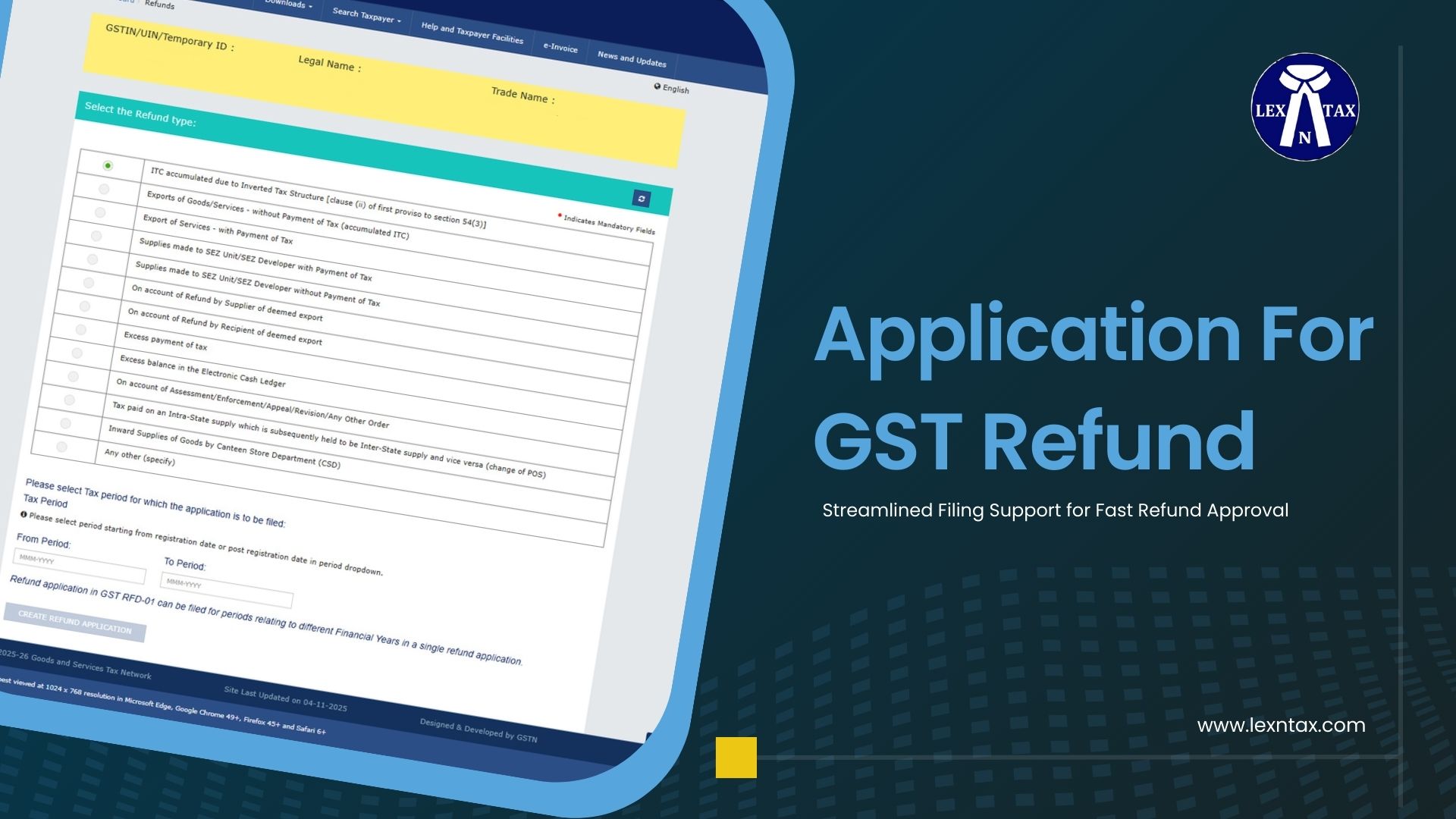
Applying for a GST refund i

Understanding who can claim

Goods and Services Tax (GST

Claiming a Goods and Servic

Starting or expanding a bus

Understanding how the GST r

For many businesses in Delh

Businesses in Delhi often f

The GST framework was intro

Maintaining accurate and we
Getting a GST refund on tim

Exporters play a crucial ro

Exporters in Delhi work in

Managing indirect taxes is

Filing an ITC refund on tim

Managing taxes is a routine

Input Tax Credit plays a ce

Input Tax Credit refund is

A Complete Guide fo

Claiming a GST refund can b
Understanding GST R