
A Complete Guide for Businesses
Understanding GST refund rules is essential for any business operating in Delhi. Refunds help maintain smooth cash flow, especially for exporters, service providers and businesses dealing with an inverted duty structure. With periodic updates in the law, it’s important to stay aligned with the GST refund new rules so that your claims are accurate and processed on time.

This guide explains the new GST refund rules, eligibility criteria, documentation, timelines and the steps involved in the GST refund process. It has been written in clear, natural language to support search visibility and answer common user queries directly.
GST refund rules define the legal framework for claiming a refund of excess tax paid, accumulated input tax credit or tax paid on exports. In Delhi, businesses must follow both central notifications and state-level guidelines issued by the Delhi GST Department. These rules outline who can apply, how to file, which documents to upload and how refunds are verified.
The primary objective is to avoid unnecessary blockage of working capital and ensure that taxes paid in excess are returned to the taxpayer within the prescribed time.
Delhi has a large base of exporters, e-commerce sellers, service providers, registered dealers and manufacturing units. Most of these businesses frequently deal with ITC accumulation, zero-rated supplies or tax adjustments.
Following the new GST refund rules helps businesses:
• Avoid errors in filing
• Reduce refund rejections
• Speed up processing
• Maintain proper documentation
• Improve compliance and audit preparedness
Whether your business deals with domestic supply or international exports, understanding the GST refund process is a must.
The government regularly updates refund rules to improve transparency and reduce delays. The GST refund new rules focus on standardising documentation, tightening eligibility norms and promoting digital processing.
Here are key updates that Delhi taxpayers should keep in mind:
1. Mandatory Aadhaar Authentication
All businesses applying for refunds must complete Aadhaar verification. Applications from unverified taxpayers may face processing delays.
2. Real-Time Data Verification
Refund applications are now cross-verified with GSTR-1, GSTR-3B, e-invoices and e-way bills. Mismatches delay approval.
3. Stricter ITC Matching
Only ITC reflecting in GSTR-2B is considered eligible for refund. Books or internal records alone are not accepted.
4. Rule Changes for Exporters
Exporters claiming refund of IGST must ensure that shipping bill data matches GST returns. Any discrepancy in invoice value or port code can lead to withholding.
5. Faster Processing Through Automated Systems
Many refund categories are now processed automatically through the GSTN backend, reducing manual intervention.
Delhi businesses can claim refunds under several categories. Understanding these helps in selecting the correct application type on the portal.
1. Refund of Excess Tax Paid
Mistakenly paid tax under the wrong head (CGST vs. IGST) or paid tax twice.
2. Refund of Export of Goods or Services
Exports are zero-rated, so businesses can claim a refund either of IGST paid or accumulated ITC.
3. Inverted Duty Structure Refund
Applicable when the input GST rate is higher than the output GST rate.
4. Refund on Supplies to SEZ Units
Supplies to SEZ developers or units are eligible for ITC-based refunds.
5. Refund for Deemed Exports
Suppliers of deemed export goods can claim refunds with supporting documentation.
6. Refund of Excess Cash in Electronic Cash Ledger
Any balance deposited but not required for tax payment can be withdrawn.
You can apply for a refund if your business meets any of the following conditions:
• You paid excess tax by mistake.
• You export goods or services.
• You have accumulated ITC due to an inverted tax structure.
• You supply goods or services to SEZ units.
• You have unutilised balance in the cash ledger.
• You made payments under protest and are eligible for reversal after adjudication.
Eligibility depends on proper compliance, so your GSTR-1, GSTR-3B and GSTR-2B must match accurately.
Delhi businesses must follow the official procedure on the GST portal. Below is the complete workflow explained in simple terms.
Step 1: Log in to the GST Portal
Visit the GST portal and open the “Refunds” section under “Services”.
Step 2: Choose the Refund Category
Select the correct refund type such as export refund, excess tax refund or ITC refund under inverted duty structure.
Step 3: Upload Required Documents
Depending on the refund category, upload documents such as:
• Statement of invoices
• Export shipping bills
• Bank realisation certificates
• Ledger statements
• Declarations and undertakings
Step 4: File the Refund Application (RFD-01)
Fill out details carefully, attach supporting evidence and submit the application with a digital signature.
Step 5: Track Application Status
You can check updates through the ARN generated after submission.
Step 6: Verification by Officer
The Delhi GST officer reviews your application, verifies ITC, checks invoices and confirms export data.
Step 7: Refund Approval
If the claim is valid, the officer issues RFD-06 and the refund is credited to your bank account.
Step 8: Rejection or Deficiency Memo
If documents are incomplete, the officer issues RFD-03. You must correct and reapply.
Although the required documents vary based on the refund category, businesses generally need the following:
• GSTR-1 and GSTR-3B mismatch report
• Invoice statement
• Export documentation (if applicable)
• Proof of tax payment
• Declaration for no unjust enrichment
• Bank account details
• Electronic credit ledger details
Ensuring clear and complete documentation speeds up the refund.
Despite improvements in the system, businesses often face challenges such as:
• Data mismatch between GSTR-1 and GSTR-3B
• ITC not appearing in GSTR-2B
• Errors in invoice values
• Delay in shipping bill updates
• Technical glitches on the GST portal
• Incorrect refund category selection
These challenges can be avoided with proper compliance, regular reconciliation and expert support.
Many businesses in Delhi choose professional GST refund service providers to reduce compliance burdens. Expert teams help with:
• Identifying eligible refunds
• Preparing accurate applications
• Matching ITC records
• Avoiding common errors
• Managing refund queries
• Ensuring timely refunds
Professional support reduces risk and helps businesses stay compliant throughout the financial year.
The GST refund rules in Delhi are designed to support businesses with smooth cash flow and better compliance. With periodic updates in the new GST refund rules, it is important to stay informed and follow the correct process. If your business deals with exports, high ITC accumulation or complex transactions, accurate filing becomes even more important. A structured and compliant approach ensures quicker refunds and fewer rejections.

Finance Minister has announ

In today’s dynamic bu

Lex N Tax Associates offers

Managing income tax filings

International taxation is t

Goods and Services Tax (GST

Income tax is one of the ma

Running a business in India

In a world with a fast-pace

The Goods and Services Tax

Smart tax planning tips for

Taxation and compliance in

In India, the popularity of

In recent years, India has

Filing your Income

In today's fast-paced b

In India's evolving reg

Running a business in Delhi

In today’s business e

In India, MSMEs (Mi

Tax season can be overwhelm

Navigating an incom

Filing income tax in India

Running a business means ju

Exports play a vital role i

For Delhi-based manufacture

For many businesses, especi

Getting a GST refund in Ind

In today’s fast-chang

Updated as per the latest G

The Goods and Services Tax

For many Delhi businesses,

The Goods and Services Tax

The Goods and Services Tax

When it comes to running a

Navigating the GST refund p

The rise of e-commerce in I

Understanding how GST refun

Businesses in India depend

Exporters depend on smooth
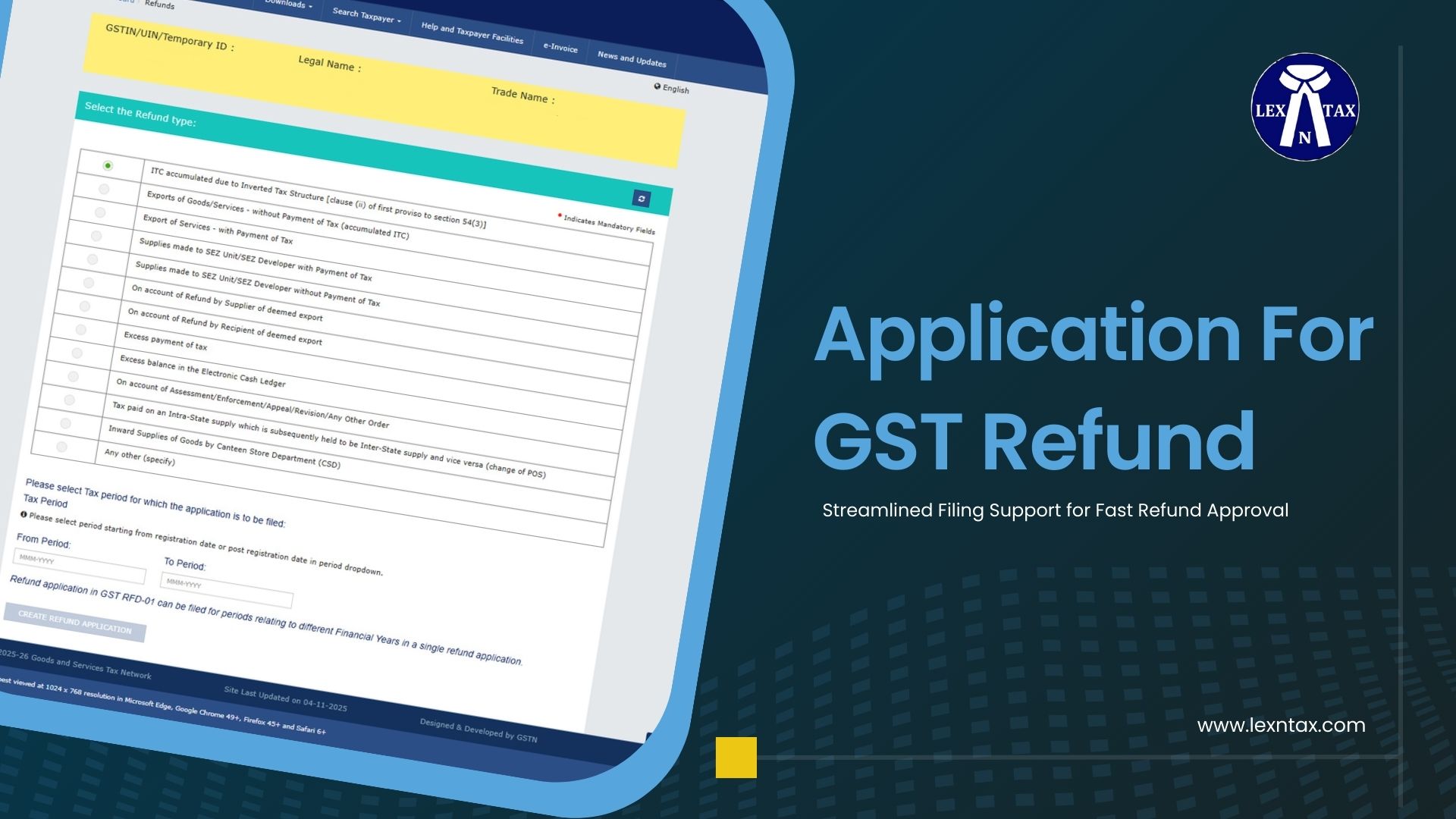
Applying for a GST refund i

Understanding who can claim

Goods and Services Tax (GST

Claiming a Goods and Servic

Starting or expanding a bus

Understanding how the GST r

For many businesses in Delh

Businesses in Delhi often f

The GST framework was intro

Maintaining accurate and we

Getting a GST refund on tim

Exporters play a crucial ro

Exporters in Delhi work in

Managing indirect taxes is

Filing an ITC refund on tim

Managing taxes is a routine

Input Tax Credit plays a ce

Input Tax Credit refund is
A Complete Guide fo
Claiming a GST refund can b
Understanding GST R